From 4
The Fast Way
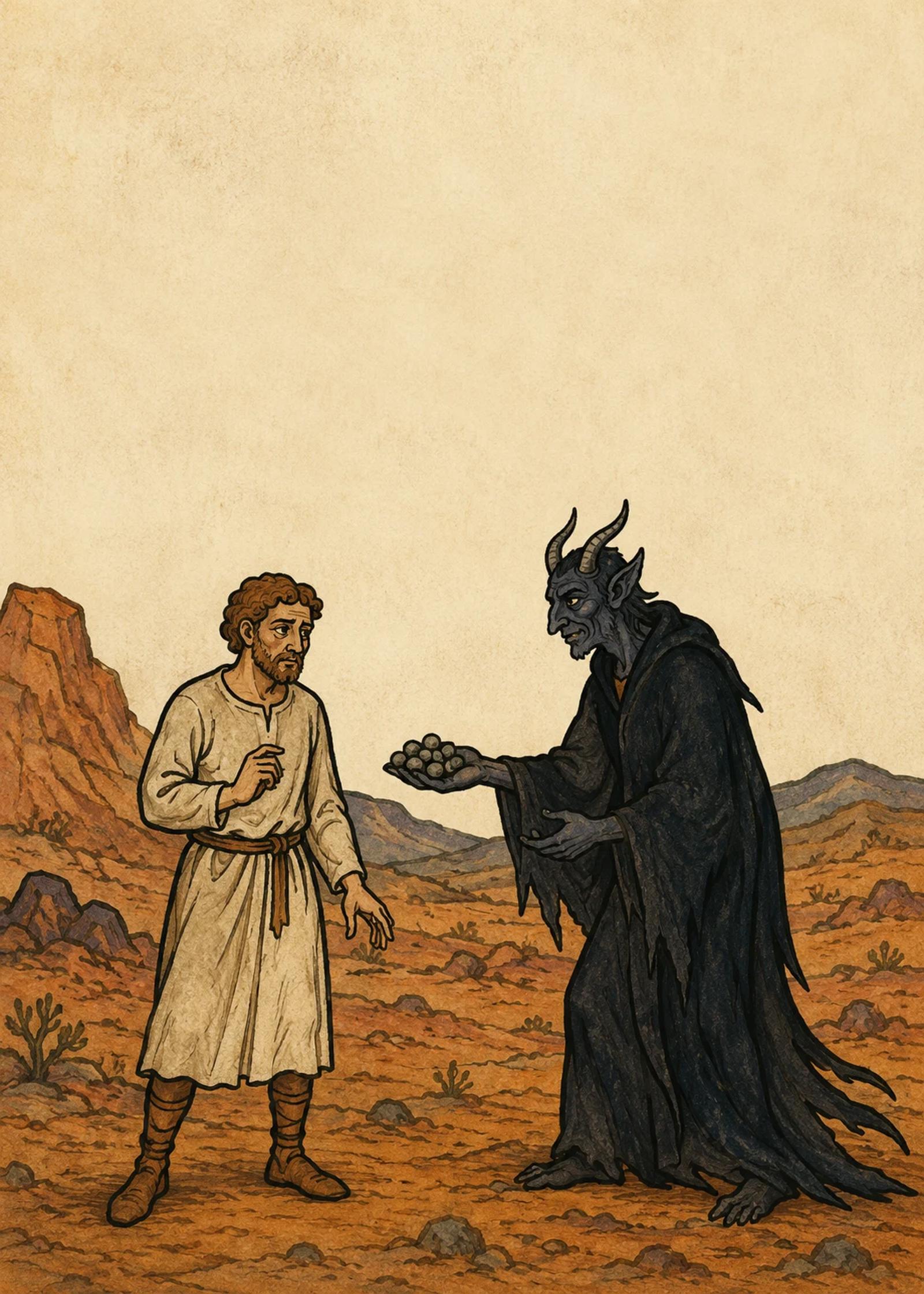
is alone in the desert for forty days. No food, no people, only sand and his own thoughts. He's exhausted and starving.
And then the devil comes walking alongside him. He sounds friendly and he has three suggestions. The clever thing is: all three sound perfectly reasonable.
*You're hungry. Look, stones everywhere. Turn them into bread.*
*Go stand on the highest point of the temple and jump. Angels will catch you, and the whole city will see. Then everyone will know at once who you are.*
*Look at all the countries of the world. Yours, today. All you have to do is bow down for a moment.*
Three times he says no. Not because food, or being seen, or having something to say are bad things. But because he doesn't want to get them this way.
Then the devil is gone. And he's still standing there. Hungry. And he just has to start walking.
For today
Does this sound familiar?
You've been stuck on the same level for days and it just won't work. In the app you see: buy this upgrade and you'll have it instantly. You buy it. You win. But within a couple of minutes the fun's gone, because you haven't really won anything — and you're out some money too.
Or you're writing a project on volcanoes and you paste in a chunk of text you don't even understand yourself. You get a great mark. And when someone asks you a question about your own project afterwards, you don't quite know where to look.
The shortcut works, almost every time. Only you know how you got there.

Earn it properly? Why would I. I'll just buy it and act like I pulled it off myself!
Take a look in the mirror:
- When did you last take the shortcut? What did it get you, and what did it cost you?
- What would you love to be able to do without ever having to practise for it?
- If you knew for certain no one would ever find out — would you cheat? Really think about it before you say no.
Mirror line
I'd love to just buy it, but I've learned a shortcut never gives you the satisfaction of something you actually earned.
From 5
Hitting the Brakes
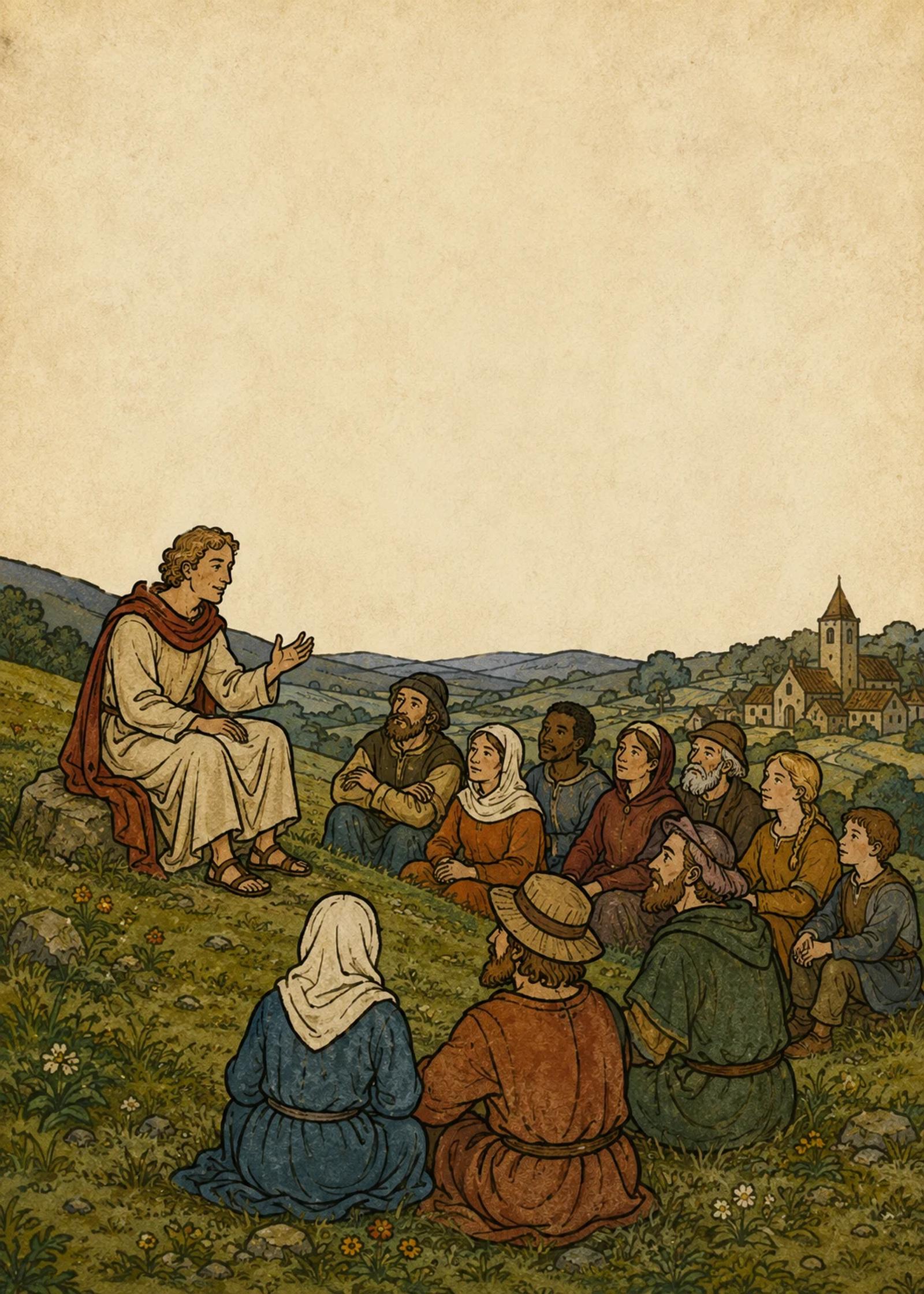
sits on a hillside with a big crowd around him. He starts talking about a rule everyone knows: an eye for an eye. If someone hurts you, you're allowed to hurt them back exactly as much. Neatly measured out.
And then he says something strange. Someone slaps your one cheek? Turn the other cheek towards him.
He gives another example like it. Back then a soldier was allowed to force you to carry his bag for a . Jesus says: carry it two miles.
That's not weak surrender. It's something else. As long as you automatically hit back, the other person decides what you do. The moment you do something he didn't see coming, you're the one choosing again.
For today
Does this sound familiar?
Your little brother pokes you in the side. You poke back. Within a minute it's war in the back seat.
Do absolutely nothing just once — no sighing, no looking, nothing — and something strange happens. He pokes you again. And then it stops. The fun was your reaction.
But this doesn't always work. With teasing, almost always. With real bullying, day after day, it doesn't work, and it's also not your job to solve that on your own. Then the strongest move isn't your other cheek, but getting someone else involved.
That's not tattling and it's not weakness. You're bringing in someone bigger than the problem.
Stay calm? Not a chance. I'm hitting back as hard as I can — with interest!
Take a look in the mirror:
- When did doing nothing back help, and when did it just make things worse?
- When were you the one who kept poking until the other person got angry?
- Who would you bring in if you couldn't handle it alone anymore?
Mirror line
I'd love to hit back as hard as I could, but I've learned that whoever hits back automatically is still doing exactly what the other person wanted.
From 7
The Sawdust in Your Eye
tells a little joke. Really, it's meant as a joke.
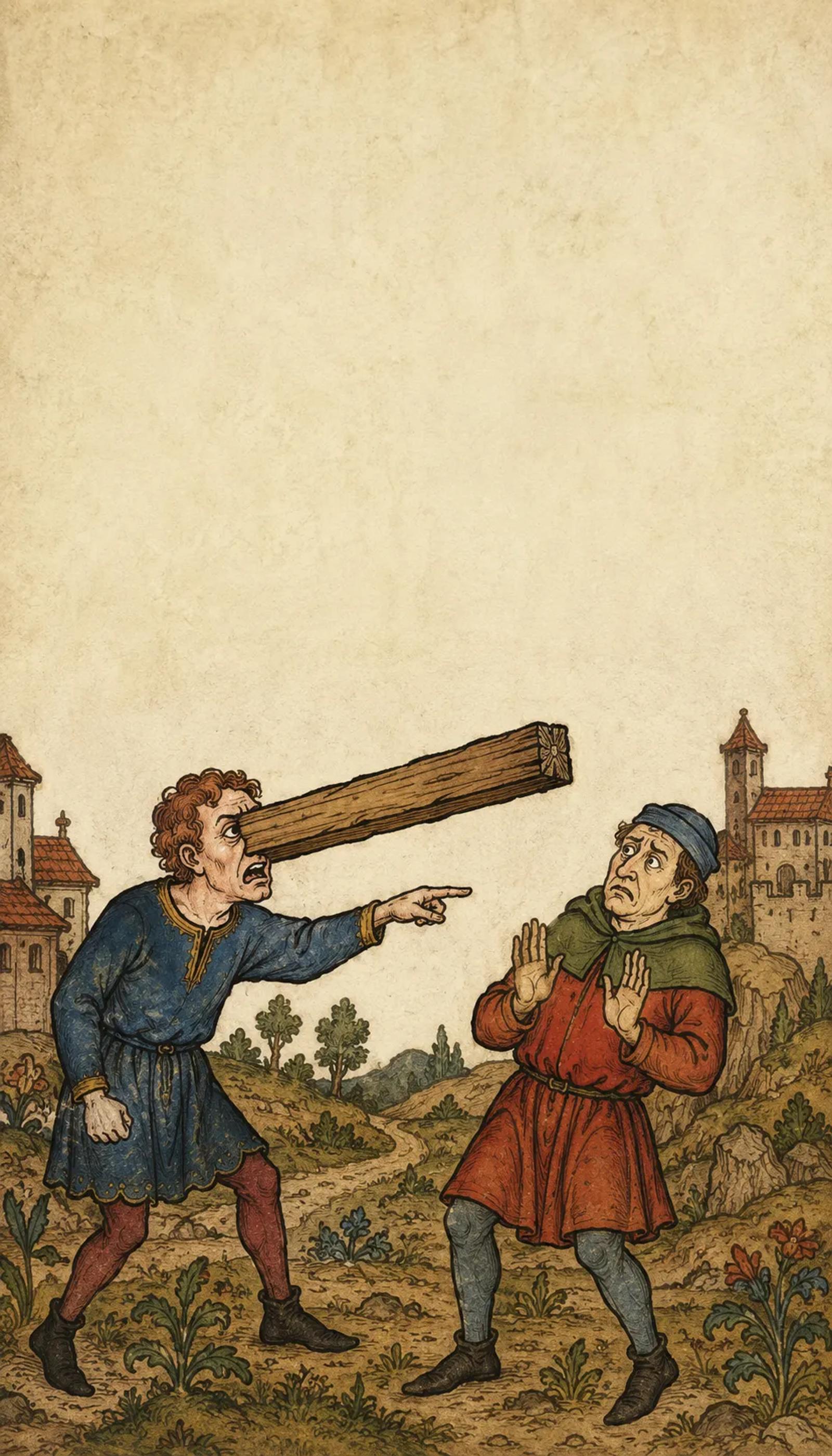
Picture someone saying to his neighbour: hang on, there's a little splinter in your eye, let me take it out for you.
Except that man has a plank in his own eye. A whole plank. A roof beam.
The people listening have to laugh, because the picture is ridiculous. Someone like that can't see anything at all. He can't even get that plank anywhere near the other person's eye.
And then comes the line that flips the joke around: take the plank out of your own eye first. Then you'll see clearly enough to actually help your neighbour.
For today
Does this sound familiar?
You yell through the house that your little sister has thrown her shoes in the middle of the hallway again. Meanwhile your own room looks like something exploded in it.
Or at school. You think it's really rude that someone keeps talking over the teacher, and you say so to two other people. What you conveniently forget to count is that you did the exact same thing yesterday.
The strange thing is you don't see it in yourself. Not because you're lying. But because you look at yourself from the inside, and at someone else from the outside. With yourself, you know why you did it. With someone else, you only see what he did.
Look at myself? I don't think so. I'd rather point at her mess and leave my own plank exactly where it is!
Take a look in the mirror:
- What are you strict about in someone else, while you do it too?
- What would your brother or sister say if someone asked: what does he actually do that's annoying?
- Who would you dare ask that question?
Mirror line
I'd love to just point at her mess, but I've learned I have a plank of my own — I just never see it.