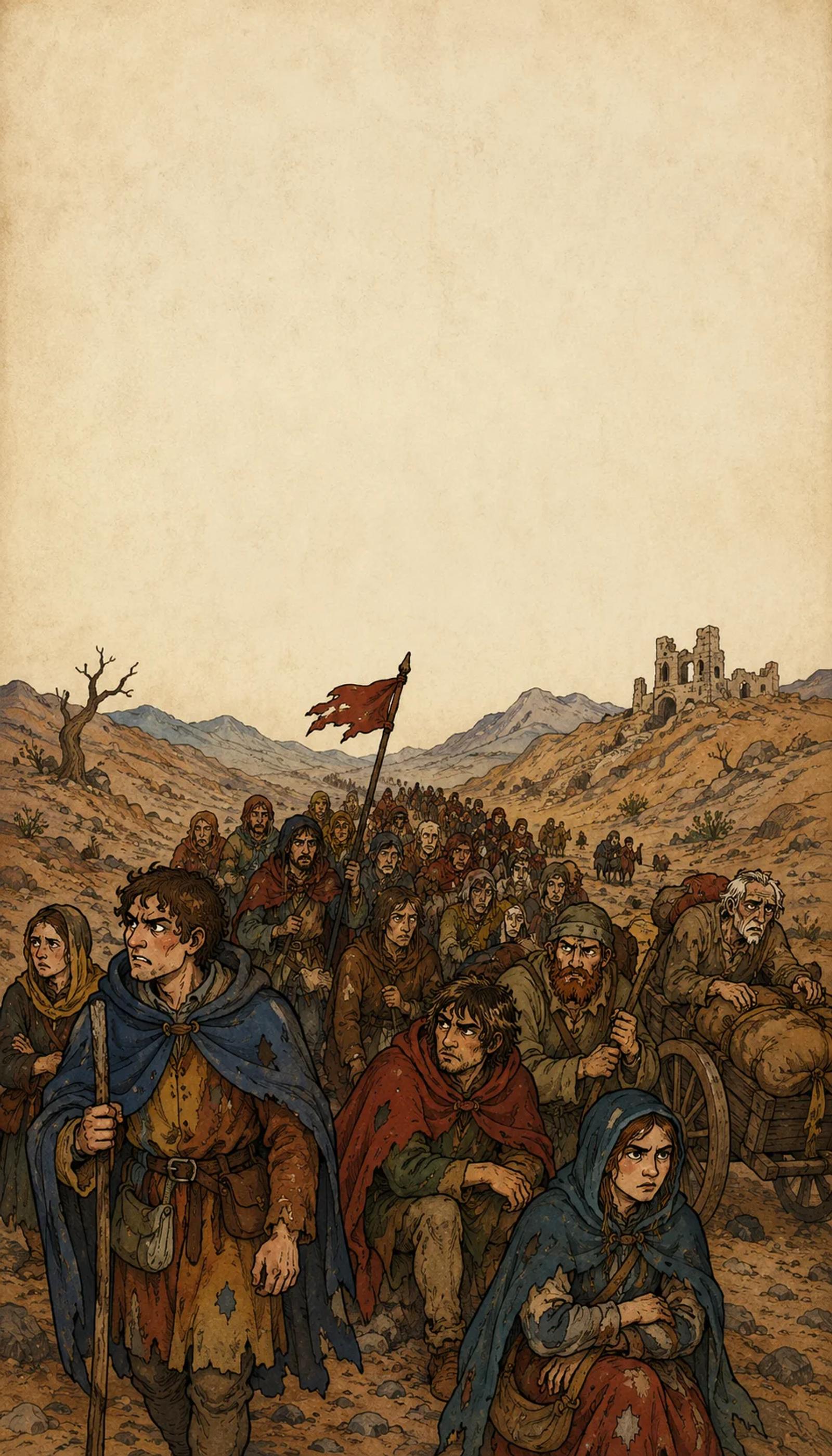
From 14
The Long, Hard Desert Journey
They're on their way to a new land. It's hot, it's heavy going, and it's taking a long time.
Twelve men are sent ahead to scout. Ten of them come back with bad news: it's beautiful there, but the people are giants and we're grasshoppers. Two say: it can be done.
The ten are the ones who get listened to.
That night the whole camp cries. They say to each other: if only we'd stayed in Egypt, at least we had food there. For a moment they forget they were slaves there.
And then they wander the desert for forty years. Children are born along the way and learn to walk in the sand; they grow up and have children of their own, without ever having seen anything but tents and rock. Only their children arrive. Not them.
For today
Does this sound familiar?
You've been at a new school for three weeks. Everything's different, you still don't know where to sit at break, and you suddenly miss your old class terribly.
Even though you were often fed up there. You know that perfectly well. You just don't feel it.
This is the hardest part. Not the beginning and not the end, but the middle. The old is gone and the new isn't here yet.
That takes everyone a while. And never exactly the same amount of time for anyone.

Keep going? Good luck to him. I'm leaving him behind with all his moaning about the good old days!
Take a look in the mirror:
- What did you want to quit because it was taking too long?
- What 'back then' do you sometimes make sound better than it was?
- What helps you when you're stuck in the middle of something that isn't finished yet?
Mirror line
I'd love to say I'm never going again, but I've learned the hardest part is always the middle — not the beginning and not the end.
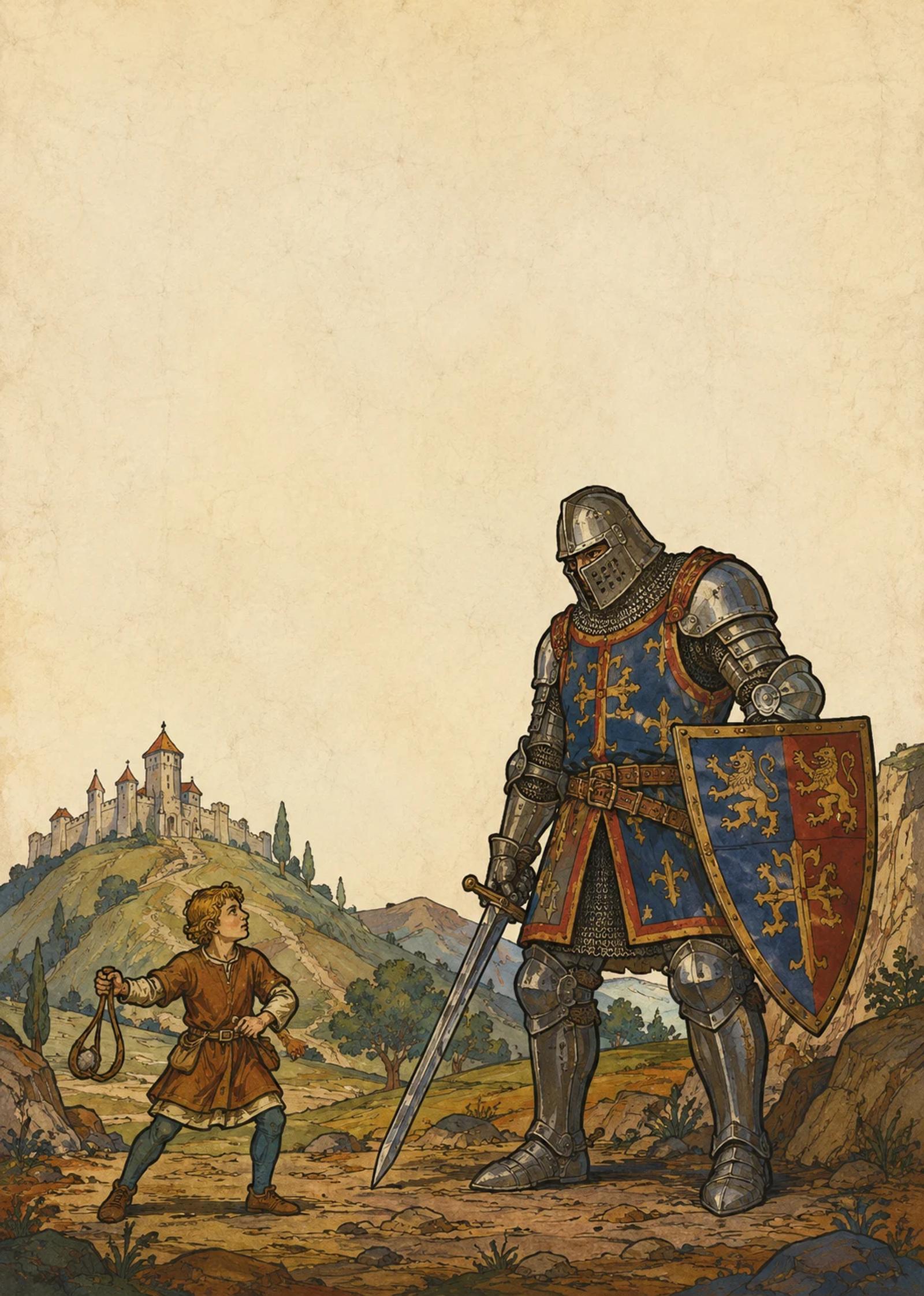
From 17
The Shepherd Boy and the Giant
Two armies stand facing each other and nothing happens. Every day steps forward and shouts: send one of your own, and we'll settle this together. He's enormous and nobody dares.
For forty days.
Then comes to bring food for his brothers. He hears it and says: I'll do it.
King Saul hangs on him. A helmet, a sword, the whole set. David takes three steps and says: I can't walk in this, I've never worn it before.
He takes it off. He grabs his stick and picks five smooth stones from the stream.
Goliath sees him coming and starts laughing.
And then it happens very fast.
For today
Does this sound familiar?
You're playing with the older kids. They shove and pull and they're two heads taller. If you try that too, you're on the ground within a minute.
But you're faster. And smaller. And you see gaps they don't see.
It's not just about sport. Someone in your class is great at talking and you're not. Try to copy him, and you can hear yourself that it sounds fake. Just say what you'd actually say, and you can hear that it's right.
Be scared? Never heard of it. I'm cutting that irritating bully down to size myself!
Take a look in the mirror:
- Whose have you tried wearing?
- What can you do that doesn't look like what everyone else can do?
- When did you feel small next to something big? What did you do then?
Mirror line
I'd love to act just as tough as he does, but I've learned you don't beat someone by putting on his armour — only by staying yourself.
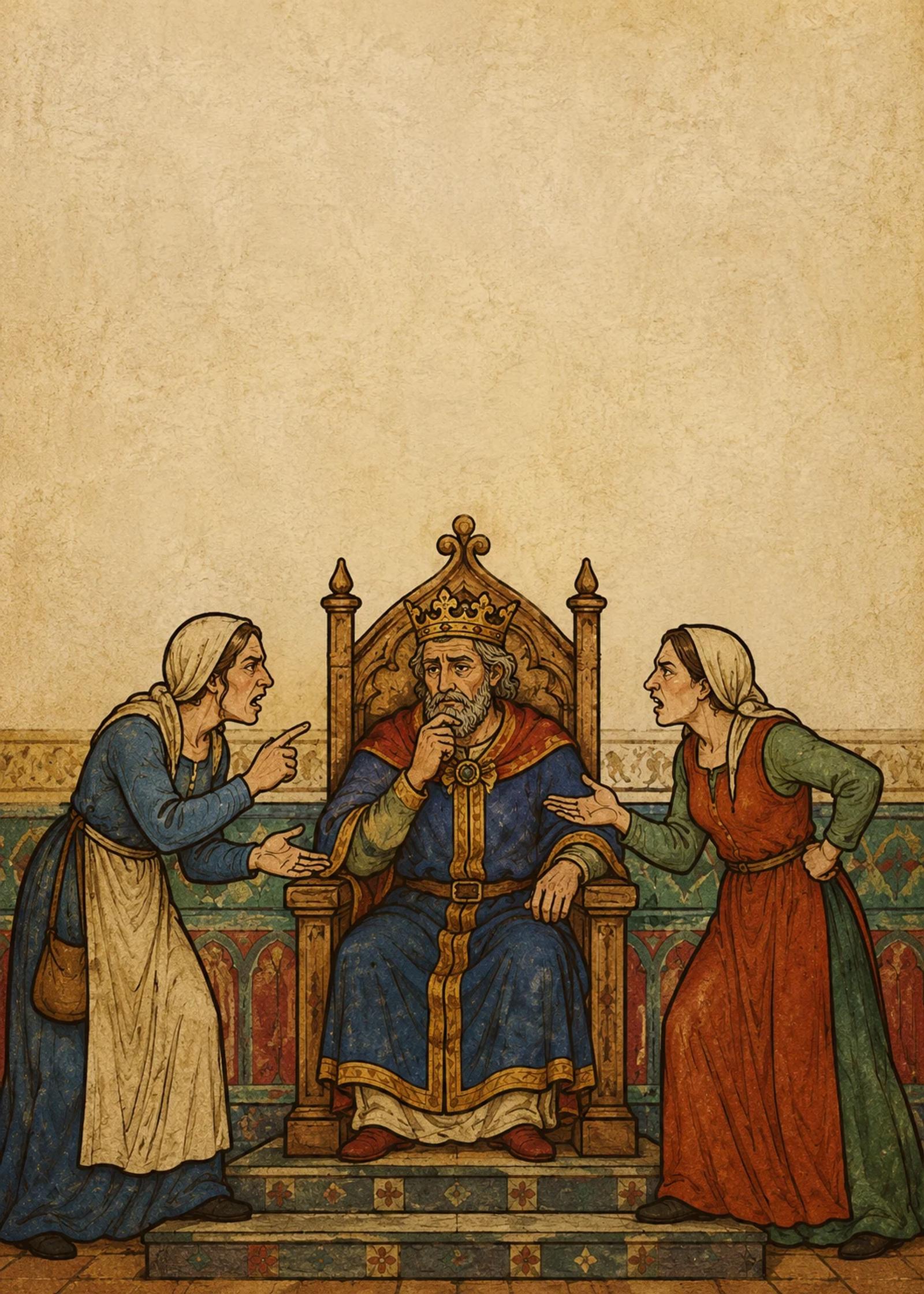
From 3
The Clever King
has only just become king and he's still young. Two women come to him, both claiming the same baby is theirs.
There are no . There's no proof. It's one woman's word against the other's.
Solomon thinks. And then he says something terrible: bring a sword. We'll cut the child in half, so each of you gets a piece.
One of the two says: fine. Go ahead. Then neither of us has him.
The other screams: no! Give him to her, then. As long as he lives.
And then Solomon knows enough. Give the child to the second woman, he says. She is the mother.
For today
Does this sound familiar?
The two of you are pulling on the same thing. You're both shouting that it's yours.
And at some point it's not about the thing anymore. It's about not wanting to give in.
You hear it start to crack. And you pull again.
If one of you lets go, the other usually thinks: I won. But the one who let go was the one who still remembered what it was actually about.
Back down? Not a chance. I'll keep pushing until it breaks — purely to win!
Take a look in the mirror:
- When did you fight so hard to be right that you forgot what it was about?
- What wouldn't you want to see broken, even if it meant losing?
- When did someone let go for your sake? Did you notice?
Mirror line
I'd love to keep nagging until I got my way, but I've learned that whoever lets go first often still remembers best what it was actually about.