From 7
The Sawdust in Your Eye
tells a little joke. Really, it's meant as a joke.
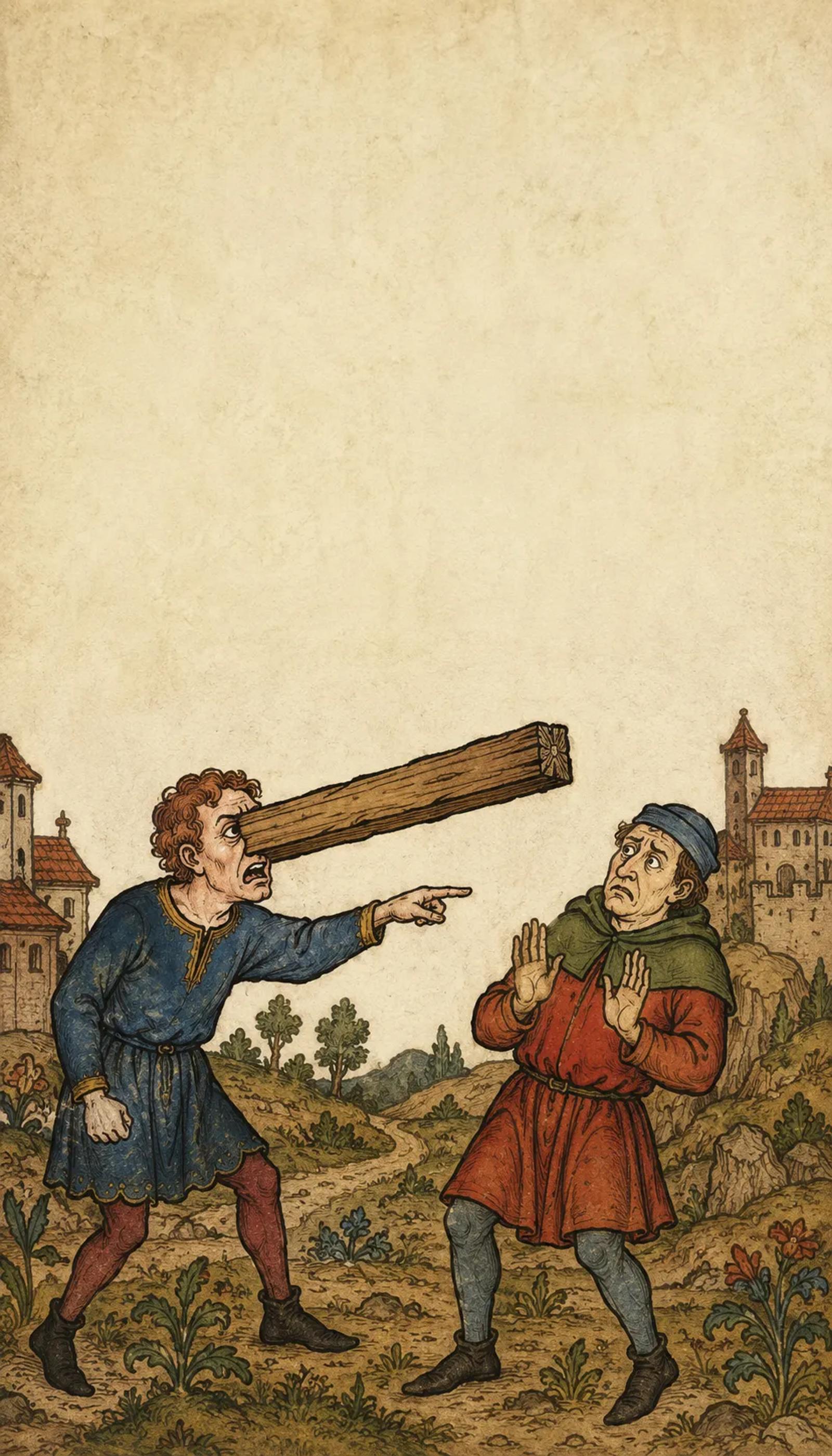
Picture someone saying to his neighbour: hang on, there's a little splinter in your eye, let me take it out for you.
Except that man has a plank in his own eye. A whole plank. A roof beam.
The people listening have to laugh, because the picture is ridiculous. Someone like that can't see anything at all. He can't even get that plank anywhere near the other person's eye.
And then comes the line that flips the joke around: take the plank out of your own eye first. Then you'll see clearly enough to actually help your neighbour.
For today
Does this sound familiar?
You yell through the house that your little sister has thrown her shoes in the middle of the hallway again. Meanwhile your own room looks like something exploded in it.
Or at school. You think it's really rude that someone keeps talking over the teacher, and you say so to two other people. What you conveniently forget to count is that you did the exact same thing yesterday.
The strange thing is you don't see it in yourself. Not because you're lying. But because you look at yourself from the inside, and at someone else from the outside. With yourself, you know why you did it. With someone else, you only see what he did.

Look at myself? I don't think so. I'd rather point at her mess and leave my own plank exactly where it is!
Take a look in the mirror:
- What are you strict about in someone else, while you do it too?
- What would your brother or sister say if someone asked: what does he actually do that's annoying?
- Who would you dare ask that question?
Mirror line
I'd love to just point at her mess, but I've learned I have a plank of my own — I just never see it.
From 19
The Full Backpack
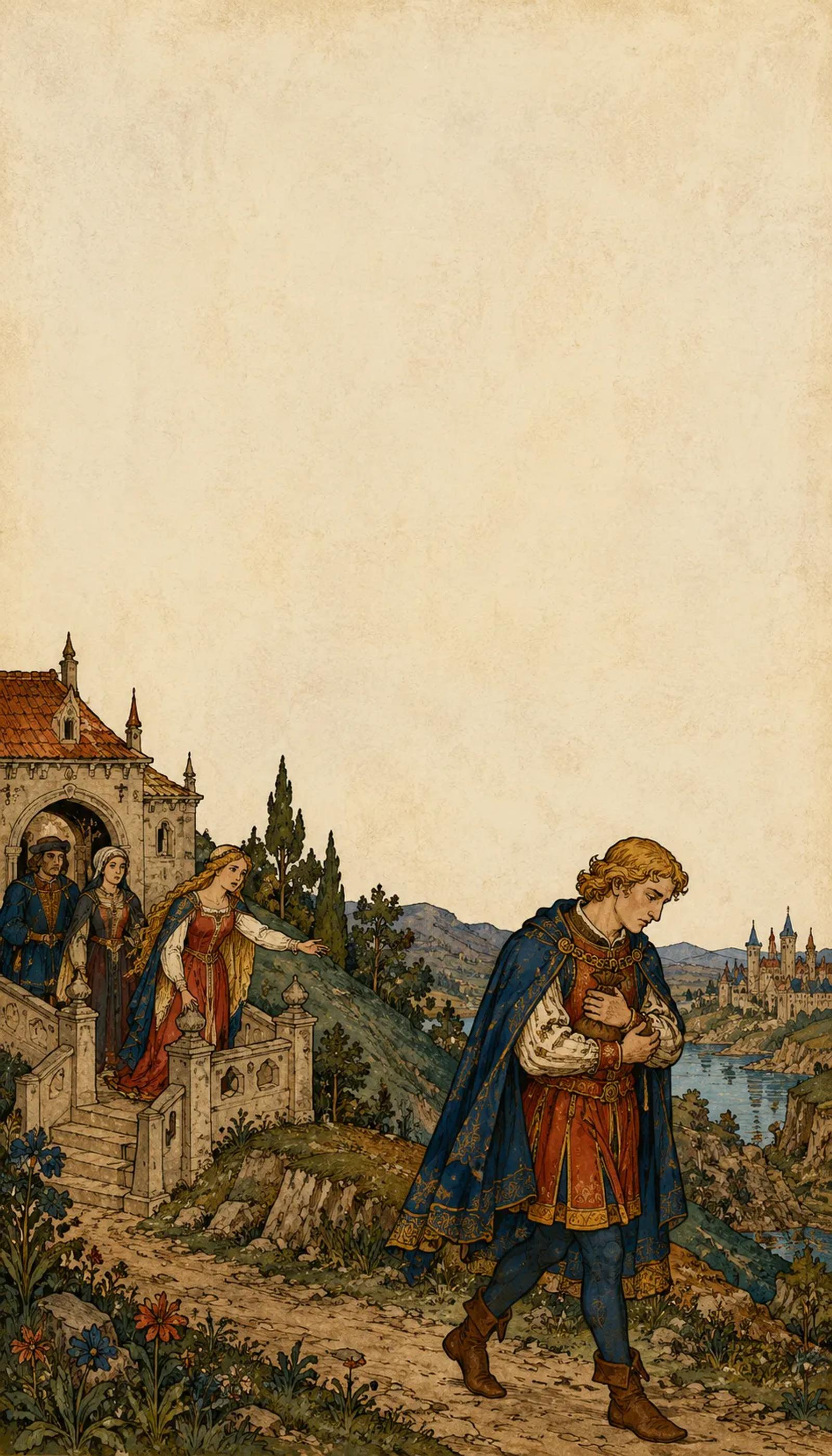
A young man comes up to . He's rich, he's kind, and he really tries hard. He asks: what else must I do to live well?
He probably expects to hear that he's doing just fine.
But the answer is: sell everything you have, give it away, and come with me.
The young man just stands there. He says nothing back. He turns around and walks away. And there's one small sentence that carries the whole story: he went away sad, for he owned a great deal.
He's not angry. He's sad. He does want to. But his things hold onto him more tightly than he holds onto them.
For today
Does this sound familiar?
You get something new that makes you really happy. And for the rest of the day you're mostly afraid of it. You don't take it outside, in case it gets dropped. You don't let anyone else hold it.
Outside they're calling you to come help with the den. And you're sitting inside trying out your new thing.
Or your suitcase for camp. You stuff it with everything you might possibly need, and on the way there you're lugging it around exhausted. Half of it never even comes out.
Share it? Absolutely not. I'm dumping all my excess baggage on someone else so I can travel light!
Take a look in the mirror:
- What do you own that you mostly guard instead of actually use?
- When did you stay inside because you didn't dare take something out with you?
- If you had to give away exactly one thing right now, what would it be? Not the easy answer — the honest one.
Mirror line
I'd love to just keep everything, but I've learned things don't make you freer — you also have to guard them, keep them clean, and not lose them.
From 10
The Hero from the Wrong Side
Someone asks : who am I actually supposed to help? Who counts as mine?
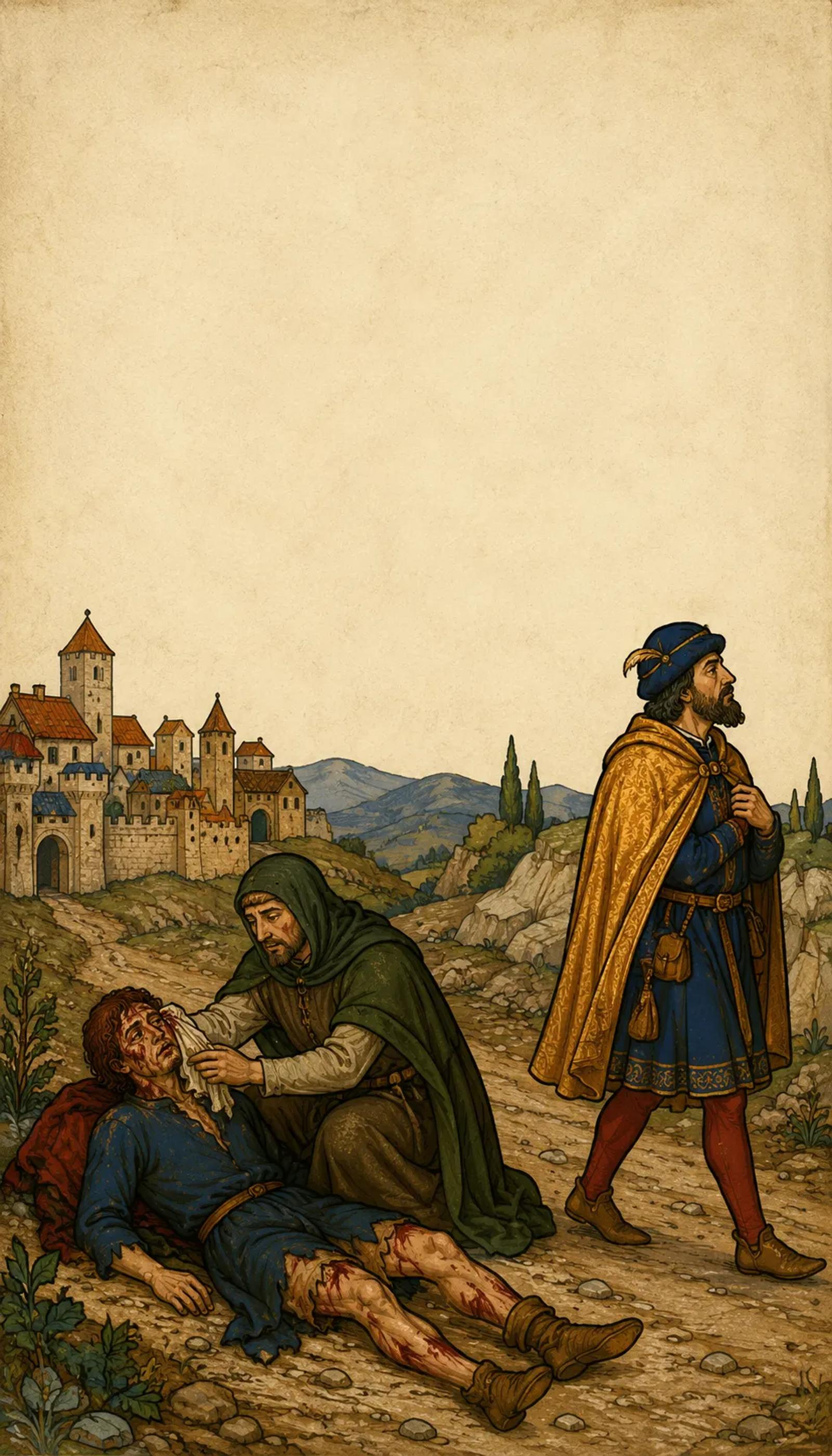
Jesus answers with a story. A man is walking down a lonely road and gets attacked. They beat him and leave him half-dead by the roadside.
Someone important comes along. He sees the man lying there, crosses over, and walks on along the other side of the road. A little later, someone else like him comes by. He crosses over too.
Then a passes. And that's exactly someone from the wrong side: the people listening to this story want nothing to do with Samaritans.
He stops. He treats the wounds, puts the man on his own donkey, brings him to an , and pays for him.
At the end, Jesus flips the question around. Not: who counts as yours? But: who became a here?
For today
Does this sound familiar?
Someone takes a hard fall on the playground. Not just anyone: it's that tough kid who was rotten to you last week. Your first thought is: serves him right.
You stop for a second. And in those few seconds you come up with three reasons to keep walking. You're going to be late. Other people are already there. And he probably doesn't even want your help.
Those reasons aren't lies. All three of them are a little bit true.
That's exactly what makes them so useful.
Stop and help? Why would I. He surely wouldn't help me either!
Take a look in the mirror:
- Who would you never help? Really think about it. You don't have to tell anyone.
- Which reason do you use most often to keep walking?
- Who helped you once when you least expected it?
Mirror line
I'd love to just keep walking, but I've learned the question isn't who deserves my help, but who I become when someone's lying there.